
If you are standing next to a freshly dug hole in your garden, or a shiny new pond liner, wondering what fish are best for outdoor ponds, you are exactly where I was eight years ago. I had a shovel in one hand and a phone in the other, scrolling through conflicting advice, and I made nearly every mistake a beginner can make.
I have now kept outdoor fish for eight years, through scorching summers, freezing winters, green-water disasters, and a few heartbreaking losses. In this guide I will tell you what fish are best for outdoor ponds for beginners, why they work, and which “pretty” fish you should leave on the shop shelf. I will also share the real mistakes that cost me money and fish, so you do not have to repeat them.
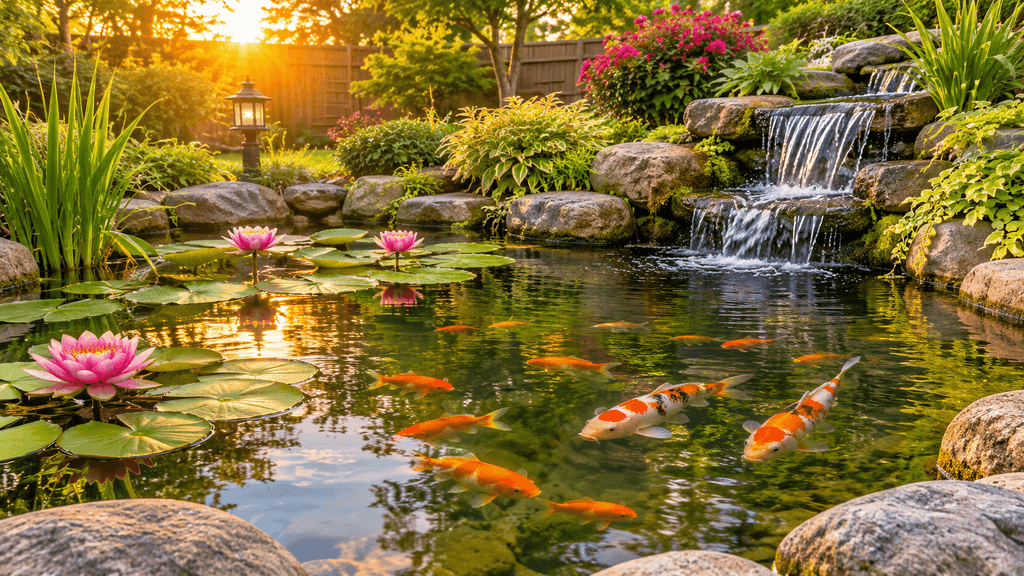
How I Got Started: My First Pond (and My First Big Mistake)
My first pond was a 200-litre plastic tub sunk into the corner of my garden. I filled it with tap water, bought eight fancy, long-finned fish from a pet shop because they looked stunning, and tipped them in the same afternoon.
Within three weeks, I had lost six of them.
I did not understand the nitrogen cycle, and I had not dechlorinated the water properly. The fish I bought were delicate indoor varieties, not hardy outdoor types. Back then I had never even asked myself what fish are best for outdoor ponds, because I assumed a fish was a fish. That assumption was expensive and, honestly, a little painful to watch.
The two survivors were plain orange common goldfish, the cheapest fish in the shop. They lived for years, outlasting every fancy fish I tried afterwards. That experience taught me the rule I still repeat to every beginner: the best fish for your first pond are the toughest, not the prettiest.
What Fish Are Best for Outdoor Ponds for Beginners? The Short Answer
Let me save you some scrolling. When people ask me what fish are best for outdoor ponds for beginners, my shortlist is:
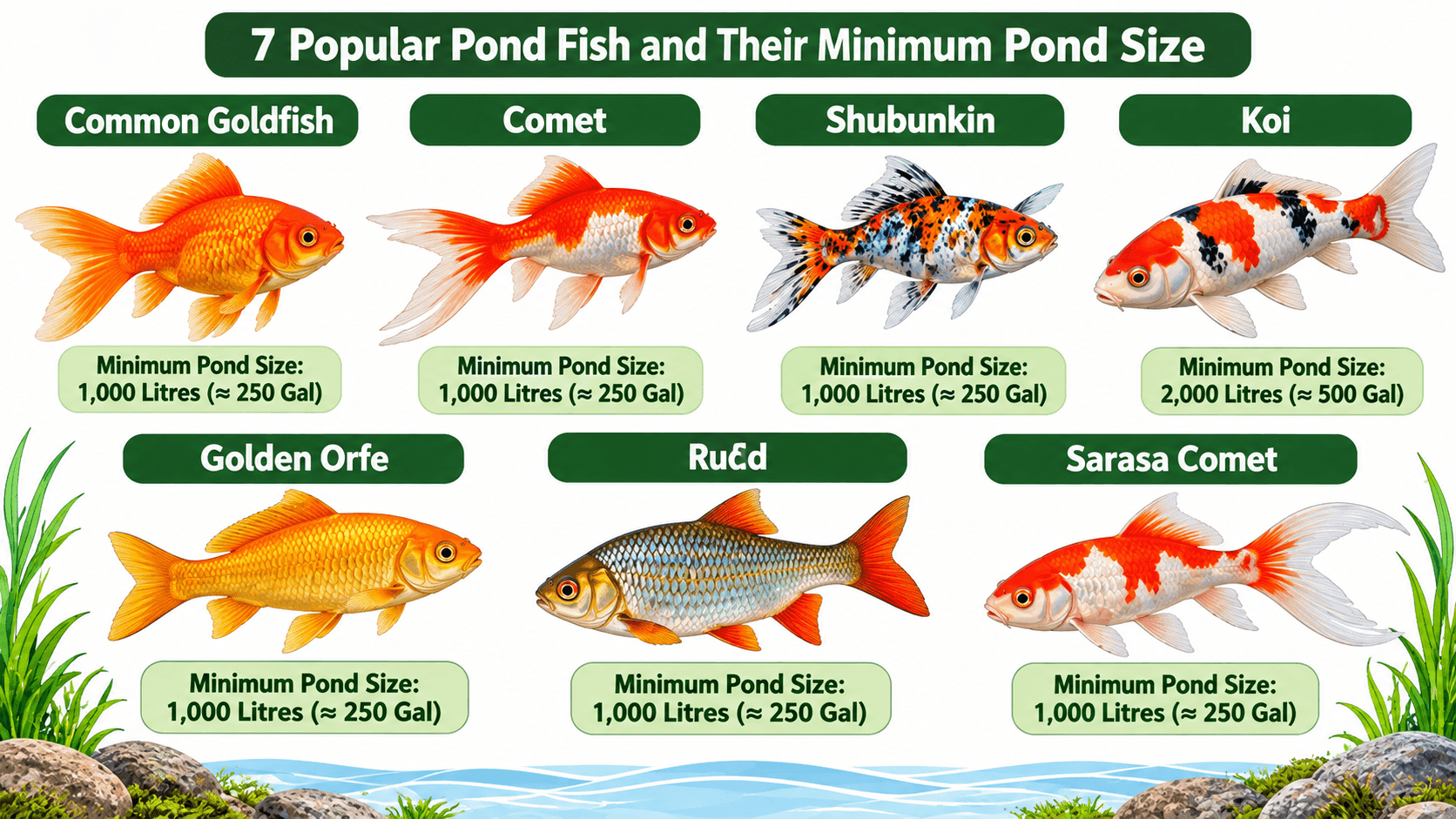
- Common goldfish – the hardiest, cheapest, and most forgiving option.
- Comet goldfish – streamlined, fast, and excellent in cold weather.
- Shubunkin goldfish – colourful and tough, with a calico pattern.
- Koi – ideal only if your pond is large and deep enough.
- Golden orfe – an active, beautiful surface swimmer for bigger ponds.
- Rudd – a hardy, shoaling fish that adds natural movement.
- Sarasa comet – a bright red-and-white variety that is easy to keep.
If you remember only one thing from this article, remember this: for a small or medium pond, the answer to what fish are best for outdoor ponds is almost always goldfish varieties. If you have a large, deep pond with strong filtration, koi and orfe become realistic choices.
Before You Buy: 5 Things That Decide What Fish Are Best for Outdoor Ponds
The truth is that no single fish is perfect for every garden. What fish are best for outdoor ponds depends on your pond, your climate, and your time. Before you spend a single rupee or dollar, check these five factors.
1. Pond Size and Volume
This is the biggest factor. A tiny tub pond cannot support a group of koi, which grow to 60 cm or more. As a rough rule, I give every fish at least 100 litres of water when it is small, and far more as it grows. Beginners almost always overstock, so start with fewer fish than you think you need.
2. Pond Depth
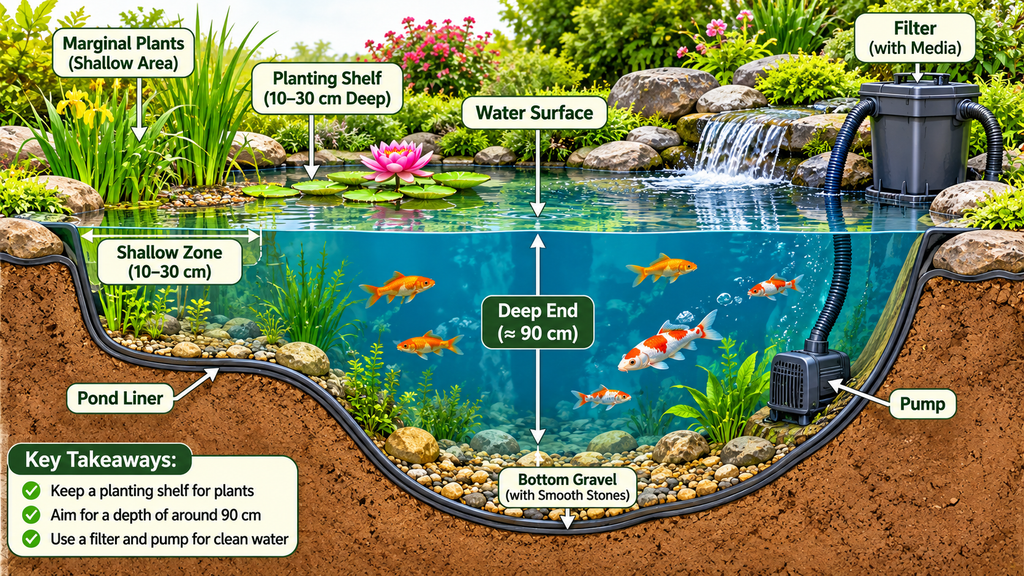
Depth protects fish from heat in summer and cold in winter. I recommend at least 60 cm (2 feet) for goldfish and 90 cm to 120 cm (3 to 4 feet) for koi. My shallow first pond swung from hot to cold so quickly that the fish were constantly stressed.
3. Climate and Temperature
If you live somewhere with freezing winters, you need fish that tolerate cold. If you live somewhere with very hot summers, you need deep water, shade, and good oxygenation. Goldfish and their relatives handle a wide temperature range, which is another reason they top the list of what fish are best for outdoor ponds for beginners.
4. Filtration and Oxygen
Fish produce waste, and waste turns toxic without a filter. A pump and filter sized for your pond volume is not optional. In summer, warm water holds less oxygen, so a fountain, waterfall, or air pump becomes your safety net.
5. Sunlight, Plants, and Shade
Plants shade the water, absorb nutrients, and give fish places to hide from herons, cats, and kingfishers. Aim to cover about 40 to 60 percent of the surface with plants like water lilies.
The 7 Best Fish for Outdoor Ponds (With My Real Experience)
Now let me go through each fish in detail. This is the practical heart of the question of what fish are best for outdoor ponds, and I will tell you honestly how each one performed in my own ponds.filter
1. Common Goldfish – The Ultimate Beginner Fish
Common goldfish are what I recommend first, every single time. They tolerate beginner water-quality mistakes, handle temperature swings, and eat almost anything. My two original survivors lived for over six years in a pond I barely understood at the time.
Pros: Cheap, extremely hardy, friendly, easy to find.
Cons: They breed readily, so you may end up with hundreds of babies in spring.
Minimum pond size: Around 500 litres for a small group.
2. Comet Goldfish – Fast and Cold-Hardy
Comets have a single long, flowing tail and a streamlined body. They are active swimmers and handle cold winters beautifully. When a freak cold snap hit my area in my third winter, my comets barely noticed it, while my fancier fish sat huddled at the bottom.
Pros: Very hardy, active, easy on the eye.
Cons: They grow larger than people expect, up to 25 to 30 cm.
3. Shubunkin – Colour Without the Fuss
Shubunkins have a calico pattern of blue, red, orange, and black splashes on a pearly body. I added three to my pond in year two and they quickly became favourites. They are just as hardy as comets but far more colourful. If a beginner asks me what fish are best for outdoor ponds when they want colour, Shubunkins are my answer.
Pros: Beautiful, hardy, social.
Cons: Slightly pricier than common goldfish.
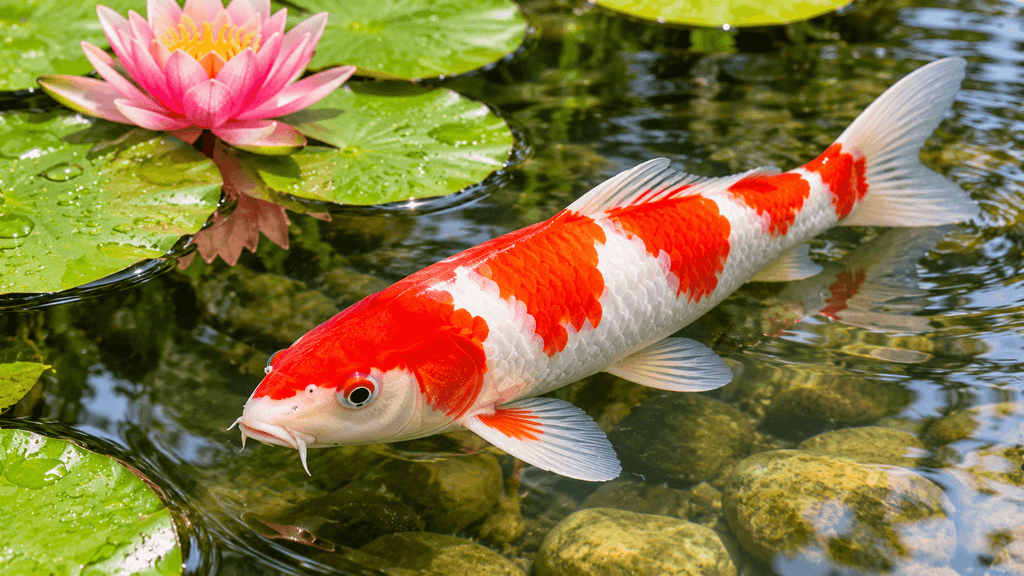
4. Koi – Beautiful, But Not for Every Pond
Koi are the stars of the pond world, and I will admit I was obsessed. I bought three baby koi for a 1,500-litre pond. Within two years, they had outgrown it. Their waste overwhelmed my filter, the water turned cloudy, and I had to rehome two of them.
Koi are wonderful, but they need big, deep ponds with strong filtration, usually at least 4,000 litres and 90 cm to 120 cm deep. When people ask what fish are best for outdoor ponds for beginners, I do not hide the truth: koi are rewarding, but they are not a first-pond fish unless you build big from day one.
Pros: Stunning, long-lived, tame enough to hand-feed.
Cons: Large, messy, expensive, and demanding on water quality.
5. Golden Orfe – The Active Surface Swimmer
Golden orfe are slim, silver-gold fish that zip around near the surface and add real movement to a pond. I kept a small shoal of three in my larger pond and loved them, but they need a lot of space and well-oxygenated water. They should be kept in groups and are best in ponds above 3,000 litres.
Pros: Graceful, active, eat insects from the surface.
Cons: Sensitive to low oxygen and poor water quality.
6. Rudd – A Natural-Looking Shoaling Fish
Rudd have silvery bodies with reddish fins and look wonderfully natural in a wildlife-style pond. They are hardy and enjoy being in groups. If you want a more natural look rather than a flashy ornamental one, rudd make a lovely choice when you are weighing what fish are best for outdoor ponds in a garden with lots of planting.
Pros: Hardy, natural look, great for shoals.
Cons: Can be skittish, and they grow bigger than many expect.
7. Sarasa Comet – Bright and Beginner-Friendly
The sarasa comet is a bright red-and-white comet goldfish. It has the hardiness of a comet with a vivid pattern that shows up beautifully against dark pond water. I recommend it to beginners who want something striking but still easy to manage.
Pros: Bright colours, hardy, active.
Cons: Can outgrow very small ponds.
Fish to Avoid in Your First Outdoor Pond
Knowing what fish are best for outdoor ponds is only half the battle. Knowing what to avoid will save you just as much heartache.
- Fancy goldfish with delicate bodies (like orandas, ryukins, and telescope-eyes). They are beautiful but struggle with temperature swings, cold, and strong competition. I lost several to the cold.
- Tropical fish (such as guppies or tetras) will die as soon as the water cools.
- Pet-shop “mystery” fish. If the label does not say pond-hardy, assume it is not.
- Large predatory fish that will eat smaller pond mates.
- Too many bottom-feeders (like plecos) that do not belong in cold or temperate outdoor ponds.
One of my early mistakes was buying a pair of fancy telescope-eye goldfish because the shop assistant said they were “perfectly fine outside.” They were not. They struggled with the first cool autumn nights, and one developed a fungal infection. The lesson is simple: when someone sells you a fish for your pond, ask whether it is truly hardy and how big it will grow.
My Biggest Beginner Mistakes (So You Do Not Repeat Them)
I promised real-life examples, so here are the mistakes that taught me the most. These are the experiences that shaped how I answer the question of what fish are best for outdoor ponds today.
Mistake 1: Adding Fish Too Soon
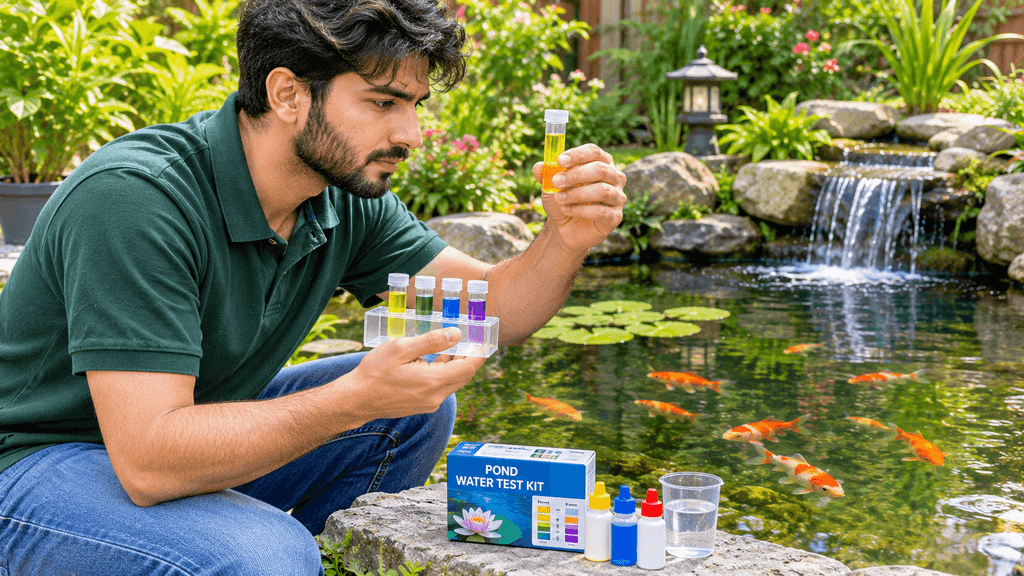
After filling my first pond, I added fish the same day. Without a cycled pond, ammonia and nitrite spiked and the fish suffered. Today I wait at least four to six weeks, and I test the water before adding a single fish. A cheap liquid test kit is one of the best investments you will ever make.
Mistake 2: Overstocking
I once kept 14 goldfish in a pond that suited about five. The water turned green, fish gasped at the surface on hot mornings, and I spent every weekend cleaning. Fewer fish means clearer water and healthier animals. Overstocking is the most common reason beginners abandon the hobby.
Mistake 3: Overfeeding
I used to think a fat fish was a happy fish. In reality, uneaten food rots and fuels algae. I now feed only what the fish finish in two to three minutes, once or twice a day in warm weather.
Mistake 4: Ignoring Predators
In my second summer, a heron visited at dawn and removed four of my best goldfish in a single morning. I had no netting, no hiding places, and no deep spots. Now I use a pond net, deeper water, and plant cover, and I have never lost a fish to a heron since.
Mistake 5: Skipping the Quarantine
I once added a new fish straight from the shop without quarantine, and it brought parasites that spread through the whole pond. I now keep new arrivals in a separate tub for at least two to three weeks.
How Many Fish Can You Keep? A Simple Stocking Guide
Beginners often ask me how many fish they can keep once they have decided what fish are best for outdoor ponds. Here is the rule of thumb I use:
- Goldfish and comets: About 100 to 150 litres of water per fish at adult size.
- Koi: At least 1,000 litres per fish, and far more is better.
- Shoaling fish like rudd and orfe: Keep at least three to five together, and give them much more room.
Always plan for adult size, not the baby size you see in the shop. A 5 cm baby comet can become a 25 cm adult within a few years. When in doubt, understock, because it is always easier to add fish later than to rehome them.
Feeding Your Pond Fish the Right Way
Good feeding keeps fish healthy and the water clean. Here is what has worked for me:
- Summer (warm water): Feed a quality pellet once or twice daily, only what they finish quickly.
- Spring and autumn: Switch to a wheatgerm-based, easily digestible food when the water cools.
- Winter (cold water): In cold climates, stop feeding when the water drops below about 8 to 10°C, as fish cannot digest food properly.
Fish are opportunists and will always beg. Do not give in. Skipping a feed day will never harm a healthy pond fish, but overfeeding often does.
Seasonal Care: Keeping Fish Healthy All Year
Even once you know what fish are best for outdoor ponds, the seasons will test your setup.
Spring: Fish wake up hungry and weak. Test the water, clean the filter gently, and start light feeding.
Summer: Watch oxygen levels. Add a fountain or air pump, give shade, and top up evaporated water with dechlorinated water. In hot climates, I also move a few floating plants in for extra cover.
Autumn: Net the pond to keep leaves out. Decaying leaves release gases that can harm fish.
Winter: Keep a small hole open in any surface ice using a pond heater or floating ring so gases can escape. Never smash ice, as the shockwaves can harm fish.
Step-by-Step: How to Start Your First Outdoor Fish Pond
Here is the exact process I now follow, and the one I teach every beginner.
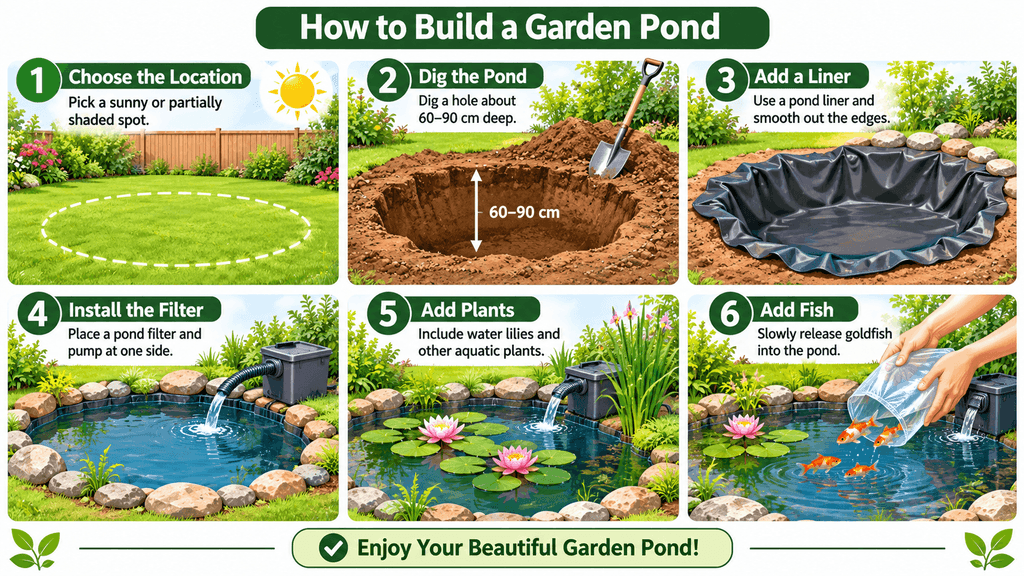
- Choose the location. Partial shade, away from overhanging trees.
- Build it deep enough. Aim for at least 60 cm, ideally more.
- Install the filter and pump. Size them to your pond volume.
- Fill and dechlorinate. Use a dechlorinator if using tap water.
- Add plants. Oxygenators and water lilies help balance the pond.
- Cycle the pond. Wait four to six weeks and test ammonia and nitrite.
- Add a few hardy fish. This is where the right answer to what fish are best for outdoor ponds really matters. Start with two or three goldfish or comets.
- Acclimatise properly. Float the bag for 20 to 30 minutes and mix in small amounts of pond water before release.
- Add more later. Give the pond a few months before adding anything else.
Common Questions About What Fish Are Best for Outdoor Ponds
What fish are best for outdoor ponds in small gardens?
For small gardens and ponds under about 1,000 litres, common goldfish, comets, and shubunkins are the best fish for outdoor ponds. Keep numbers low, and use a good filter.
What fish are best for outdoor ponds for beginners with no experience?
Common goldfish and comets are the most forgiving. They tolerate beginner water-quality slips, and they are inexpensive, so early mistakes cost less.
What fish are best for outdoor ponds in hot weather?
Hardy goldfish varieties cope well with heat as long as the pond is deep, shaded, and well oxygenated. Avoid delicate fancy goldfish in very hot conditions.
Can I keep koi and goldfish together?
Yes, you can, but koi grow much larger, and they need far more space and filtration. Make sure the pond is big enough for both.
Do outdoor pond fish need a filter?
In almost every case, yes. A filter keeps waste from turning toxic, and it keeps the water clear. Even a small pond benefits from one.
How long do pond fish live?
Common goldfish can live 10 to 20 years in good conditions, and koi can live for decades. Good water quality is the biggest factor.
Is it better to start with a few fish or many?
Always start with fewer fish. A beginner who is still learning what fish are best for outdoor ponds is much better off with three healthy fish than ten stressed ones.
Final Thoughts: Start Small, Start Hardy, and Enjoy It
After eight years, hundreds of litres of green water, and a handful of heartbreaking losses, my advice on what fish are best for outdoor ponds is simple: begin with hardy goldfish, comets, or shubunkins, build your pond deep, filter it well, and stock lightly. Once you are confident, you can move on to koi, orfe, or rudd.
If you are still unsure what fish are best for outdoor ponds in your particular garden, start with your pond’s volume, depth, and climate, and match your fish to those limits rather than to your wish list. Your pond, and your fish, will thank you.
Keeping fish outdoors should be relaxing, not stressful. Every mistake I made was a lesson, and I hope reading about them helps you skip the painful parts and go straight to the joy of watching healthy fish glide through your very own garden pond.
Pingback: - How to Keep Outdoor Fish Pond from Freezing